





Think about a family clinic in Toronto that buzzes with activity or a mid-sized hospital in Chicago in which patient records are everywhere: paper files, spreadsheets, and unconnected digital systems. The receptionists have a hard time locating previous visit notes, billing errors are accumulating, and follow-up appointments are being poorly managed.
The outcome? Unhappy patients, lost revenue, and staff that are done for the day but still have a lot of work to do.
Now, imagine one system where every patient’s history, appointment schedule, communication log, billing status, and follow-up reminders are all kept together accessible to the authorized staff with just one click. This is what a healthcare-specific CRM does.
In brief: if you are operating or managing a clinic, private practice, or hospital that caters to patients in the US or Canada; healthcare CRM software in USA and Canada implementation is a data chaos solution, an improvement of patient relationships, and a giant leap in operational efficiency all at one go.
What Is Healthcare CRM Software in USA & Canada
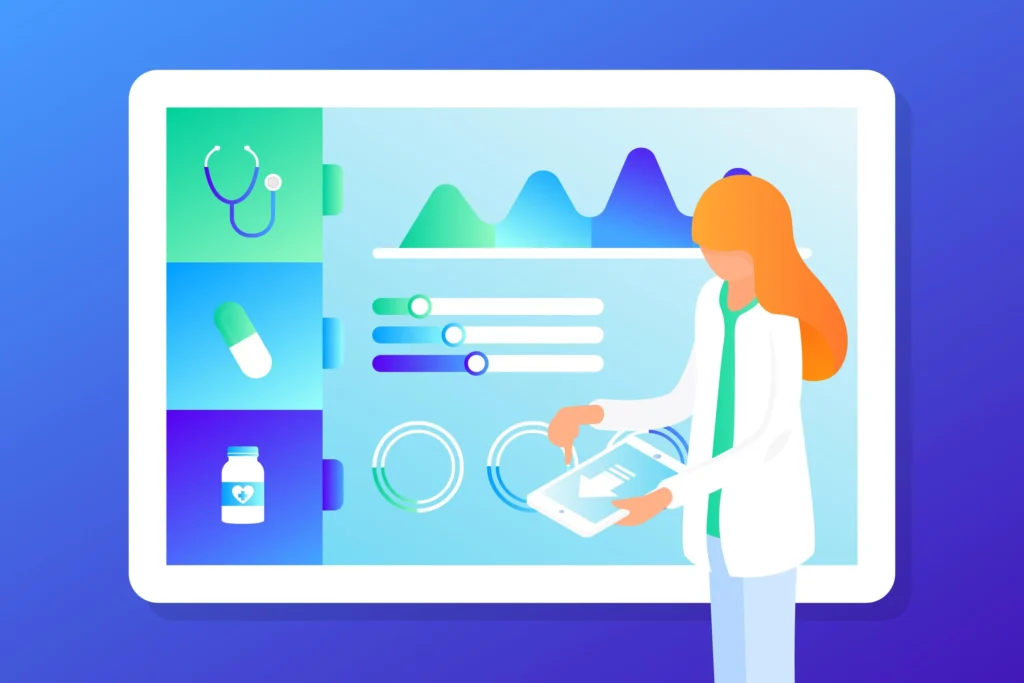
The healthcare CRM software in USA & Canada is a system that manages Customer Relationships in a medical institution, which specially suits the clinics, hospitals, and medical practices. This version is a built-in type around the patient’s care and management system, compliance with regulations, and healthcare processes.
It gets:
- Patient’s name, age, gender, contact info, and number of visits
- Appointment setting, reminders, and patient departure
- Records of calls, emails, and messages
- Billing and Payment history and invoice tracking
- Patient feedback and follow-ups.
Satisfaction metrics and analytics that show you which patients are retained, how many no-shows there are, and how much revenue you earn. The time is saved since every little thing is integrated, and the patients get the smoothest and most personalized care.
Bottom line: healthcare CRM development software can dramatically improve patient engagement, reduce errors, and accelerate revenue cycle management.
Common Problems Clinics & Hospitals Face — And How CRM Solves Them
While some healthcare facilities keep up with the latest trends, others are still dealing with outdated practices that are affecting both quality of care and profitability. Let us shed light on the problem:
Problem: Fragmented Patient Data & Poor Communication
Scenario: Clinic personnel are constantly looking for previous visit notes or taking the same tests again because the communication channels are ineffective, the result might be wrong treatments, and the patients are just fed up with telling their personal information over and over again.
Solution with CRM: The use of healthcare CRM has helped in the channeling of all the patient’s information through the unification of various departments such as billing, testing, and so on into one single profile in the system. The medical records that the staff needs to access are available on the spot, and the patients are receiving care that is consistent and well-informed.
Problem: Inconsistent Patient Engagement & Poor Retention
Scenario: Patients are never contacted after treatment. There are no reminders for annual check-ups or preventive care. Many patients move to competitors’ clinics, and the relationship remains transactional.
Solution with CRM: Make use of patient outreach campaigns — for follow-up visits, preventive screenings, or health tips — triggered automatically based on visit history. Maintain a continuous relationship rather than sporadic visits, and retention as well as patient satisfaction will be improved.
How to Implement Healthcare CRM Software Successfully

In case you are sure that you are going to get the best out of healthcare CRM, here is a practical roadmap to make it work:
Assess Needs & Vacate Clear Goals
- Draw your current workflows: What is your appointment process? Where is the patient information located? How is billing done?
- Specify your wants: patient follow-up, integrated billing, no-shows minimized, communication upgraded, analytical insights, etc.
- Establish quantitative targets: for instance, decrease no-shows by half, delay billing by thirty percent, increase patient retention by a fifth.
- Unambiguous targets function as a standard to later check whether the crm in healthcare industry implementation was successful or not.
Selecting the Proper CRM System & Partner for Implementation
Every CRM has different features. A solution that:
- Is intended (or adaptable) for medical clinics — supports patient-centered fields, HIPAA compliance (or local privacy regulation), strong access controls.
- Interconnects (or can interconnect) with current EMR/EHR systems; has no data silos.
- Provides all the appointment management, communication automation, billing modules, analytics dashboards.
- Grow with your practice — from solo clinics to multi-doctor hospitals.
- If you do not have technical expertise in-house, you might want to hire a consultant who offers healthcare CRM consulting or healthcare CRM software development services to adjust the system to your needs.
Transferring Data with Caution & Security Compliance
- Get patient records, appointment logs, billing data from old systems or spreadsheets.
- Data cleansing: eliminate duplicates, check contact info, and anonymize old records.
- Load it into the CRM while making sure that the data fields are correctly matching.
- Enforce role-based access control: only the staff that has been authorized can see or make changes to the sensitive information.
- Data migration is critical; mishandled data can lead to privacy breaches or operational chaos.
Train Staff & Define New Processes
- Conduct user training sessions on the appointment booking process, patient record reading, billing, automated reminders, and analytics reports.
- Document the new procedures: e.g., how to create a patient profile, how to send a reminder, how to record the communication.
- Assign the different roles: who is responsible for the follow-up, who is watching overdue bills, who is making performance reports.
- Skilled personnel along with unambiguous procedures will guarantee your CRM as an integral part of the daily operations — not as a silent system left to pick up dust.
Launch, Monitor and Iterate for Continuous Improvement
- Start with the pilot phase: select one department or a group of patients to try out the system.
- Collect and analyze feedback from the staff and the patients about what is good, and what is not so good and what is a little bit difficult.
- Make use of analytical dashboards to evaluate performance against your initial targets (no-show rate, revenue cycle time, patient satisfaction, etc.).
- Make changes in workflows, provide additional training, improve communication templates, or customize forms where necessary.
- System implementation is not over when it is officially launched; continuous monitoring and iteration will ensure that CRM is of long-term value.
Real-Life Example: A Small Clinic’s CRM Success Story
Think of a small dermatology clinic in Vancouver that had no luck with appointment scheduling and patient retention. Besides, the staff was overwhelmed with the combination of paper records and several calendars. A lot of patients did not even schedule follow-ups, ignored reminders, and the money from the treatments that had to be repeated remained the same.
After implementing a healthcare CRM:
- Automated appointment reminders reduced no‑shows by 45% within 3 months.
- Follow-up campaigns for treatments and check‑ups increased patient retention by 30%.
- Billing delays decreased by 25% — thanks to streamlined invoicing and payment reminders.
- Staff time spent on administrative tasks dropped by 40%, freeing them to focus on patient care.
The clinic transformed from chaotic paper‑based workflows to a streamlined, patient‑centered system — all thanks to adopting the right CRM.
Why Integration with Leading Platforms Matters

For clinics with existing enterprise‑level infrastructure, using a platform like Soft Korner can offer Microsoft Dynamics 365 implementation services in USA & Canada several advantages:
- Scalable cloud-based architecture suitable for multi-branch hospitals.
- Strong security and compliance capabilities — critical in healthcare.
- Native modules for contact management, communication automation, analytics.
- Ability to customize or extend modules for billing, patient portals, reminders, and reporting.
Whether you choose an off‑the‑shelf solution or custom‑built healthcare CRM via dedicated development services, ensure your system integrates well with your EMR/EHR and other essential software.
Conclusion
It is no longer optional but rather mandatory for clinics, private practices, or hospitals in the USA and Canada that implement modern healthcare CRM software to deal with the fragmented patient records issue, missed appointments, inefficient billing, and lost revenue which are all problems that are very real.
Contact Soft Korner today — your digital transformation partner for smarter healthcare operations.
Frequently Asked Questions
Q: What is the contrast between a CRM and an EMR/EHR system?
A: EMR/EHR systems are used for maintaining medical and clinical records while a CRM is used for purposes like patient engagement, communication, billing, and management of relationships. However, a lot of practices are using the two systems together.
Q: Will a CRM have a positive impact on the patient’s experience and thus increase retention?
A: Definitely. One of the main functions of a company that uses CRM is communication tailored to the individual, sending of reminders at the right time, and reaching out for follow-ups or preventive care, all these actions result in creating a stronger bond with the patient and loyalty.
Q: I manage a tiny clinic (2 to 3 doctors only), so should I get a CRM?
A: Certainly. The advantages that small clinics experience are decreased administrative workload, less scheduling mistakes, improved patient follow-ups, and a more professional experience. A growing practice can take advantage of CRM to enable smooth scaling.
