








Why Businesses That Adopt Agentic AI Early Will Have a Competitive Advantage
Every business wants to work faster, reduce costs, and deliver better customer experiences. The challenge is that traditional automation can only follow predefined rules. When something unexpected happens, human intervention is usually required.
This is where Agentic AI is changing the game. Instead of simply responding to commands, Agentic AI can understand objectives, plan multiple steps, make decisions, and execute tasks with minimal supervision. Businesses across the USA and Canada are beginning to adopt this technology to improve productivity, eliminate repetitive work, and create more agile operations.
Organizations that embrace Agentic AI today are positioning themselves to stay ahead of competitors as intelligent automation continues to evolve.
Why Traditional Automation Is No Longer Enough
For years, businesses relied on automation tools to speed up repetitive processes. While these systems helped improve efficiency, they often lacked flexibility.
Common challenges include:
- Manual approvals slowing down workflows
- Employees switching between multiple applications
- Delays caused by repetitive administrative tasks
- Customer requests waiting for human intervention
- Business processes breaking when exceptions occur
As organizations grow, these problems become more noticeable. Companies need intelligent systems that can think, adapt, and complete work—not just automate individual tasks.
What Makes Agentic AI Different?
Many business leaders ask, What are AI agents?
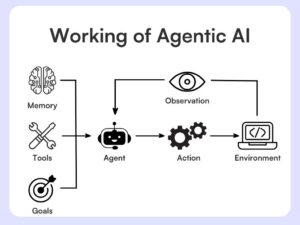
AI agents are intelligent software systems that can observe information, make decisions, and perform actions to accomplish a specific objective.
Unlike conventional automation, Agentic AI combines reasoning, planning, and execution into one intelligent process. Rather than waiting for instructions after every step, it determines the next best action based on available information.
This allows businesses to automate complete business processes instead of isolated tasks.
A Simple Business Example
Imagine a customer submits a service request.
In a traditional workflow, employees might review the request, gather information, assign it to the correct department, send notifications, and update internal systems.
With Agentic AI, these steps happen automatically. The AI analyzes the request, verifies customer information, routes it to the appropriate team, updates records, schedules follow-ups, and monitors completion.
Employees remain involved only when human judgment is truly needed.
The result is faster service and a better customer experience.
Agentic AI vs Chatbots
Many organizations believe chatbots represent the future of AI, but there is a major difference between Agentic AI vs chatbots.
A chatbot is designed to answer questions and assist users during conversations.
An Agentic AI system goes beyond conversation. It performs actions, coordinates multiple systems, solves problems, and completes workflows independently.
Instead of simply telling customers what to do, it actually helps businesses get the work done.
Where Businesses Are Using Agentic AI
The practical applications continue to grow.
Some Autonomous AI agents examples include:
- Sales assistants that qualify leads automatically
- Customer service agents resolving common issues
- HR systems managing employee onboarding
- Finance assistants processing invoices
- IT support agents handling routine service requests
Across industries, businesses are discovering new ways to reduce manual effort while improving accuracy.
Smarter Collaboration Through AI
Large organizations often require several systems working together.
This is where Multi-agent systems become valuable.
Instead of relying on one AI model, multiple specialized agents collaborate to complete different parts of a workflow.
One agent gathers information, another analyzes it, while another executes business actions. This collaborative approach improves both speed and accuracy.
AI Beyond the Workplace
Businesses aren’t the only ones benefiting.
Developers are creating AI agents for home automation that manage lighting, security, climate control, appliances, and energy consumption with minimal user input.
These intelligent assistants continue learning household routines, making homes more efficient and convenient.
The Next Generation of Intelligent Automation
Companies are moving beyond simple automation toward Smart automation with AI agents.
Instead of automating one repetitive task, businesses can automate complete customer journeys, internal approvals, reporting, scheduling, and operational processes.
This allows employees to spend more time solving strategic problems instead of handling repetitive administrative work.
Technologies Driving Innovation
Modern development platforms are making adoption easier.
Frameworks like LangChain AI agents allow developers to build intelligent applications capable of reasoning, using external tools, remembering previous interactions, and coordinating complex tasks.
These technologies are accelerating enterprise AI adoption across North America.
Improving Workflow Efficiency
Organizations are increasingly investing in AI agent workflow automation to streamline everyday operations.
Whether processing customer requests, managing support tickets, or coordinating internal approvals, intelligent agents reduce delays and improve consistency.
The result is better operational performance with fewer manual touchpoints.
Why Early Adoption Matters
The biggest Benefits of agentic AI extend beyond automation.
Businesses gain:
- Faster business operations
- Lower operational costs
- Higher employee productivity
- Better customer satisfaction
- More accurate decision-making
- Greater scalability
- Improved operational resilience
Companies that begin experimenting today will gain valuable experience before autonomous AI becomes an industry standard.
Looking Toward 2026
Experts believe the Future of agentic AI 2026 will include AI systems capable of handling increasingly sophisticated business operations with minimal oversight.
Organizations that invest early will have stronger data foundations, better-trained teams, and more mature AI strategies than competitors that wait.
Rather than replacing people, Agentic AI will increasingly become a trusted digital teammate that enhances human productivity and enables businesses to achieve more with the resources they already have.
Final Thoughts
The shift toward autonomous intelligence has already begun. Businesses across the USA and Canada are discovering that Agentic AI is more than another technology trend—it is becoming a practical way to improve efficiency, reduce repetitive work, and make smarter operational decisions.
Organizations exploring digital transformation should identify repetitive processes where intelligent agents can deliver measurable value. At Soft Korner, we help businesses integrate modern AI solutions that support long-term growth, operational excellence, and innovation.
Frequently Asked Questions
Is Agentic AI only for large enterprises?
No. Businesses of all sizes can adopt Agentic AI to automate workflows and improve efficiency.
Can Agentic AI work with existing business software?
Yes. Many solutions integrate with CRMs, ERPs, help desks, and cloud platforms.
Does Agentic AI replace employees?
No. It automates repetitive work while allowing employees to focus on strategic and creative responsibilities.
Why are businesses investing in Agentic AI now?
Growing operational demands and advances in AI technology make it an effective way to increase productivity and remain competitive.
