








How AI Is Transforming AI Field Service in 2026
Field service has always been one of the most challenging parts of running a business. Whether it’s maintaining industrial equipment, repairing HVAC systems, servicing medical devices, or managing utilities, companies must balance customer expectations, technician availability, travel time, and equipment reliability.
In 2026, Artificial Intelligence (AI) is changing that equation.
Instead of reacting to equipment failures or manually assigning technicians, organizations are using AI to predict issues before they happen, automate scheduling, optimize dispatching, and help technicians solve problems faster. The result is lower operational costs, higher first-time fix rates, and a significantly better customer experience.
For businesses across the USA and Canada, AI is no longer an experimental technology—it’s becoming a competitive advantage in AI field service management.
Why Traditional Field Service Is No Longer Enough
Many field service organizations still rely on spreadsheets, manual scheduling, phone calls, and reactive maintenance.
This creates common challenges such as:
- Long customer wait times
- Inefficient technician routes
- Unplanned equipment downtime
- Missed service appointments
- High fuel and travel costs
- Low first-time fix rates
As customer expectations continue to rise, businesses need smarter systems that can make decisions in real time.
That’s exactly where AI is making the biggest impact.
AI-Powered Scheduling Improves Workforce Efficiency
Scheduling dozens or even hundreds of service appointments every day is a complex task.
Traditional scheduling often depends on dispatchers manually matching technicians with jobs. This process becomes difficult when emergencies, cancellations, or traffic delays occur.
AI-powered scheduling analyzes multiple factors simultaneously, including:
- Technician availability
- Required certifications
- Customer location
- Traffic conditions
- Service priority
- Equipment history
Instead of spending hours rearranging appointments, AI automatically builds optimized schedules that reduce travel time while maximizing technician productivity.
Businesses benefit from:
- Faster response times
- More appointments completed daily
- Reduced overtime
- Better workforce utilization
Predictive Maintenance Prevents Costly Breakdowns
One of AI’s most valuable contributions is predictive maintenance.
Rather than waiting for equipment to fail, AI continuously analyzes sensor data, maintenance records, and operating conditions to detect early warning signs.
For example, AI may identify:
- Abnormal temperature increases
- Excessive vibration
- Pressure fluctuations
- Performance degradation
- Irregular power consumption
Instead of unexpected failures, maintenance teams receive alerts before problems become serious.
This allows organizations to:
- Reduce emergency repairs
- Extend equipment lifespan
- Lower maintenance costs
- Minimize operational downtime
Industries such as manufacturing, healthcare, energy, and transportation are already seeing measurable improvements from predictive maintenance strategies.
Intelligent Dispatching Gets the Right Technician to the Right Job
Sending the wrong technician wastes both time and money.
AI-driven dispatching considers much more than technician availability.
It evaluates:
- Skills and certifications
- Parts inventory
- Previous repair experience
- Distance to the customer
- Current workload
- Service-level agreements
The system automatically assigns the technician most likely to resolve the issue on the first visit.
This leads to:
- Higher first-time fix rates
- Reduced repeat visits
- Faster service delivery
- Improved customer satisfaction
Customers receive quicker service while technicians spend less time traveling between jobs.
Remote Diagnostics Reduce On-Site Visits
Not every problem requires a technician to visit the customer’s location.
Modern AI systems can analyze connected equipment remotely before dispatching anyone.
Remote diagnostics help businesses:
- Detect software issues
- Analyze sensor readings
- Review device performance
- Identify probable failures
- Recommend corrective actions
In many cases, technicians can resolve problems remotely through software updates or configuration changes.
When an on-site visit is necessary, technicians already know:
- The likely cause
- Required replacement parts
- Estimated repair time
This dramatically improves service efficiency.
Customer Self-Service Is Becoming Smarter
Today’s customers expect fast answers without waiting on hold.
AI-powered self-service portals allow customers to:
- Schedule appointments
- Track technician arrival
- Troubleshoot common issues
- Receive maintenance recommendations
- Access equipment documentation
Conversational AI assistants can answer questions around the clock, reducing call center volume while giving customers immediate support.
If an issue requires human assistance, AI collects relevant information before transferring the request, allowing technicians to arrive fully prepared.
Technician Copilots Are Changing Field Work
One of the most exciting developments in 2026 is the rise of technician copilots.
Instead of searching through manuals or contacting senior engineers, technicians can use AI assistants that provide real-time guidance during service visits.
A technician copilot can instantly:
- Recommend troubleshooting steps
- Identify compatible replacement parts
- Summarize equipment history
- Generate service reports
- Suggest safety procedures
- Answer technical questions
This reduces training time for new employees while helping experienced technicians solve complex issues more efficiently.
Technician copilots also automate documentation, allowing workers to focus more on repairs and less on paperwork.
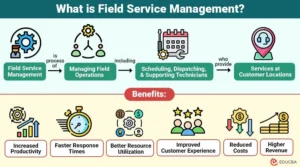
The Business Benefits of AI in Field Service
Organizations adopting AI-powered field service solutions are reporting measurable improvements across operations.
Common benefits include:
- Faster response times
- Improved technician productivity
- Lower operational costs
- Reduced equipment downtime
- Higher customer satisfaction
- Better resource allocation
- Increased first-time fix rates
- More accurate forecasting
These improvements translate directly into stronger profitability and better customer retention.
Preparing for the Future
AI adoption in field service is accelerating, but successful implementation requires more than simply purchasing new software.
Organizations should begin by:
- Digitizing service records
- Connecting equipment through IoT devices
- Standardizing workflows
- Training employees on AI tools
- Integrating AI with CRM and field service platforms
Businesses that build a strong digital foundation today will be better positioned to take advantage of future AI innovations.
Final Thoughts
AI is redefining field service by making operations more proactive, intelligent, and customer-focused. From AI-powered scheduling and predictive maintenance to intelligent dispatching, remote diagnostics, customer self-service, and technician copilots, every stage of the service journey is becoming faster and more efficient.
Visit the Soft Korner website today to get a free demo!
For organizations across the USA and Canada, adopting AI isn’t simply about automation—it’s about delivering exceptional service while reducing costs and empowering technicians with the tools they need to succeed.
As field service continues to evolve in 2026, businesses that embrace AI today will be better equipped to meet customer expectations, improve operational performance, and stay ahead in an increasingly competitive marketplace.
Soft Korner | Digital Transformation Partner
Frequently Asked Questions
1. How does AI improve field service scheduling?
AI automatically assigns jobs based on technician availability, skills, location, traffic, and service priority, improving efficiency and reducing travel time.
2. What is predictive maintenance?
Predictive maintenance uses AI and equipment data to identify potential failures before they happen, helping businesses reduce downtime and repair costs.
3. Can AI reduce field service visits?
Yes. AI-powered remote diagnostics can identify and sometimes resolve issues remotely, eliminating unnecessary on-site visits.
4. What is a technician copilot?
A technician copilot is an AI assistant that provides real-time troubleshooting guidance, equipment history, repair recommendations, and automated documentation during service calls.
