






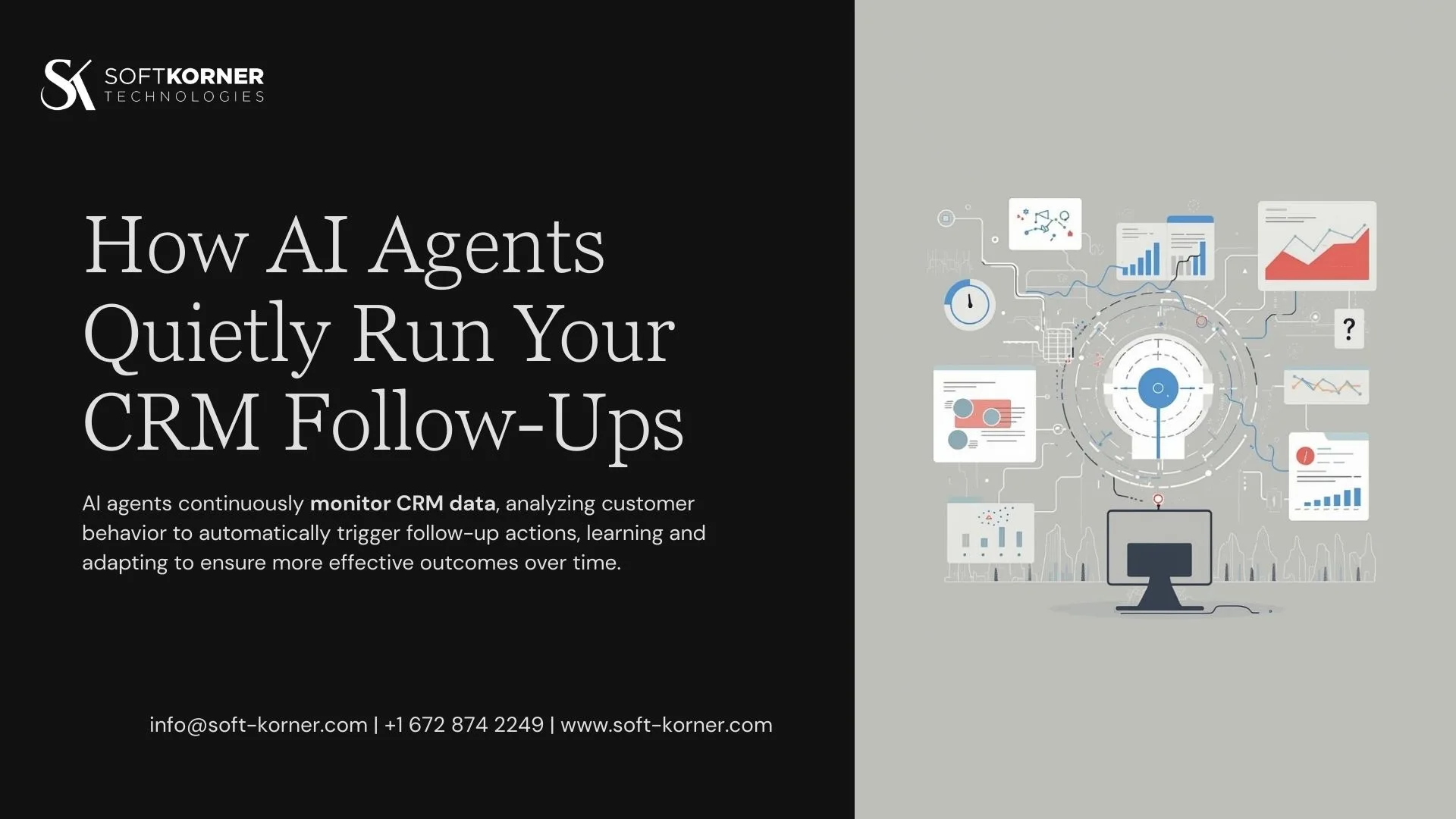
If your small business is losing deals because follow-ups are late, inconsistent, or forgotten entirely, the solution is simpler than hiring more staff. Modern ai agents now automate CRM follow-ups intelligently — sending timely emails, booking calls, nurturing leads, updating records, and even qualifying prospects without human intervention.
Soft Korner for small businesses across the USA and Canada, this means:
- No more manual reminder tracking
- No more cold leads due to delayed responses
- No more inconsistent sales communication
- Higher conversion rates with less overhead
In short, ai agents turn your CRM from a passive database into an active revenue engine.
This guide explains exactly how they work, how to implement them step-by-step, and how small businesses are using them to increase sales without increasing payroll.
What Are AI Agents in CRM Follow-Ups?

ai agents are intelligent software systems that can independently perform tasks, make decisions based on data, and continuously improve over time. Inside a CRM, they automate communication workflows, analyze customer behavior, and trigger personalized follow-ups automatically.
Unlike traditional automation tools that follow fixed rules, ai agents:
- Learn from interaction history
- Adapt follow-up timing based on engagement
- Personalize messaging dynamically
- Score leads based on buying signals
- Trigger multi-channel communication
Instead of simply sending “Email 1 after 3 days,” they determine when and how to follow up based on real customer behavior.
For example, if a prospect opens an email twice but doesn’t reply, the system might schedule a personalized check-in call. If someone clicks pricing pages multiple times, it may escalate them to the sales team automatically.
That’s the difference between automation and intelligent execution.
The Real Problem Small Businesses Face
Small businesses in North America struggle with follow-ups for five main reasons:
- Sales teams are overloaded
- Leads enter CRM but go cold
- Manual data entry creates delays
- Follow-up timing is inconsistent
- No centralized tracking system
Studies consistently show that responding within the first 5 minutes increases conversion chances dramatically. But most small teams respond hours — sometimes days — later.
This gap is exactly where ai agents operate.
They ensure no lead is ignored, no email is delayed, and no opportunity slips through the cracks.
For the best AI CRM automation services, visit the Soft Korner website today!
How AI Agents Automate CRM Follow-Ups Step-by-Step
Step 1: Intelligent Lead Capture
When a potential customer fills out a website form, downloads a guide, or engages with your ads, ai agents automatically:
- Capture the lead in your CRM
- Enrich data using public information
- Assign a lead score
- Categorize based on intent
An AI Agent for lead generation ensures that inquiries from multiple sources — website, social media, email campaigns — are consolidated and structured instantly.
This removes the need for manual entry and reduces response time to seconds.
Step 2: Instant Personalized Response
Speed matters. Once a lead enters the CRM, ai agents trigger personalized responses.
Instead of generic templates, the system customizes:
- Name and company references
- Product interest
- Geographic relevance (USA or Canada region)
- Industry-specific messaging
An AI Agent for marketing ensures follow-up emails align with campaign messaging and customer journey stage.
This immediate communication builds trust and increases engagement.
Step 3: Behavior-Based Follow-Up Sequences
Traditional CRM automation sends emails on fixed schedules.
ai agents, however, monitor:
- Email opens
- Link clicks
- Website visits
- Pricing page interactions
- Previous replies
If a prospect shows buying signals, the follow-up accelerates. If engagement drops, the tone and frequency adjust automatically.
An AI Agent for automation adapts timing instead of relying on static workflows.
This significantly increases reply rates.
Step 4: Sales Prioritization and Lead Scoring
Not all leads are equal. ai agents analyze patterns to determine which prospects are most likely to convert.
They assess:
- Company size
- Interaction frequency
- Purchase behavior
- Past CRM data
- Engagement depth
An AI Agent for sales then flags high-priority prospects and schedules reminders for the sales team.
Your team focuses on warm leads while the system nurtures colder ones automatically.
Step 5: Automated Multi-Channel Communication
Modern customers don’t only respond to email.
ai agents coordinate across:
- SMS
- LinkedIn messages
- Chatbots
- Calendar booking tools
An AI Agent for CRM synchronizes conversations so all interactions are logged and visible in one dashboard.
This eliminates fragmented communication and ensures consistency.
Step 6: Smart Re-Engagement Campaigns
Many small businesses forget about dormant leads.
ai agents periodically analyze inactive contacts and:
- Send re-engagement messages
- Offer limited-time promotions
- Share new product updates
- Trigger reminder sequences
An AI Agent for workflow automation ensures these campaigns run continuously without manual setup.
Instead of losing past leads, you reactivate them automatically.
Real-Life Example from North America
A Toronto-based B2B service company struggled with inconsistent follow-ups. Their sales team manually tracked leads in spreadsheets.
After implementing ai agents in their CRM:
- Response time dropped from 12 hours to under 2 minutes
- Lead conversion increased by 28%
- Administrative workload reduced by 40%
- Follow-up consistency improved across all campaigns
The key difference was intelligent behavior-based triggers instead of static reminders.
The system handled routine communication while the team focused on closing deals.
Why AI Agents Work Better Than Traditional CRM Automation

Traditional automation is rule-based.
If X happens, send Y.
But customers don’t behave predictably.
ai agents use data-driven analysis to:
- Adjust communication timing
- Modify messaging tone
- Predict buying intent
- Recommend next best action
An AI Agent for customer support also integrates ticket systems to ensure no customer query is left unanswered, automatically escalating urgent issues.
The result is proactive engagement instead of reactive follow-up.
Implementation Guide for Small Businesses in USA & Canada
1. Audit Your CRM Workflow
Identify:
- Where leads enter
- Where delays occur
- Where follow-ups are inconsistent
- Where manual tasks consume time
This helps determine where ai agents should be deployed first.
-
Define Follow-Up Objectives
Decide what you want to improve:
- Faster response times
- Higher meeting bookings
- Better lead qualification
- Reduced manual effort
Clear goals ensure effective configuration.
-
Integrate AI with Your Existing CRM
Most modern CRMs support AI integration.
An AI Agent for business integrates with platforms like:
- Microsoft Dynamics
- HubSpot
- Salesforce
- Zoho
The integration enables data syncing and automated triggers.
-
Train the System on Historical Data
The more data available, the better ai agents perform.
Upload:
- Past email sequences
- Conversion data
- Lead sources
- Customer profiles
This improves predictive accuracy.
-
Monitor and Optimize
Even though ai agents operate independently, periodic review improves results.
Track:
- Open rates
- Response rates
- Conversion metrics
- Sales cycle length
Continuous refinement ensures maximum ROI.
Benefits for Small Businesses
Implementing ai agents in CRM follow-ups provides:
- 24/7 automated engagement
- Lower operational costs
- Improved customer experience
- Data-driven sales insights
- Reduced human error
For small teams with limited resources, this creates enterprise-level capability without enterprise-level budgets.
The Future of CRM Follow-Ups
Small businesses can no longer rely on manual reminders or static workflows.
Customers expect:
- Instant replies
- Personalized engagement
- Consistent communication
- Quick booking options
ai agents meet these expectations without increasing operational costs.
They transform your CRM from a storage tool into an intelligent assistant that works continuously.
Businesses that adopt this early gain a competitive advantage in both the USA and Canada markets.
Final Thoughts
If your small business struggles with delayed responses, inconsistent follow-ups, or low conversion rates, the solution is not hiring more staff — it’s implementing intelligent automation.
By deploying ai agents strategically within your CRM, you ensure:
- Every lead gets immediate attention
- Every prospect receives personalized communication
- Every opportunity is tracked and nurtured
- Every sales representative focuses on closing, not chasing
Digital transformation begins with smarter systems, not bigger teams.
If you’re ready to automate CRM follow-ups intelligently and scale sustainably, now is the time to take action.
Connect with experts who understand how to implement intelligent CRM automation the right way — and turn your follow-up process into your strongest revenue driver.
Frequently Asked Questions
How quickly can AI agents start improving follow-ups?
Most businesses see noticeable improvements within 30 to 60 days after proper setup and data training.
Are AI agents expensive for small businesses?
Costs vary by CRM and integration level, but many solutions are scalable and affordable for SMB budgets in the USA and Canada.
Do AI agents replace sales teams?
No. They handle repetitive tasks so sales professionals can focus on relationship building and closing deals.
Can AI agents personalize communication?
Yes. They analyze customer behavior, past interactions, and demographic data to create context-aware follow-ups.
Are AI agents secure for CRM data?
When integrated properly with compliant platforms, they follow data security standards applicable in North America.
What industries benefit most?
B2B services, SaaS companies, real estate firms, healthcare providers, financial services, and eCommerce businesses see strong results.
How do AI agents handle unresponsive leads?
They automatically schedule follow-up sequences, change messaging tone, or mark leads for long-term nurturing.
Can AI agents integrate with marketing campaigns?
Yes. They align sales and marketing communication for seamless customer journeys.
